


FabBRICK: The Future of Construction
- Esme Carty
- Jan 13
- 2 min read

Written by Esme Carty
Close your eyes and think of Paris. What is the first word or image to come to mind? Perhaps it is the luxury fashion brands that were born from this iconic city. Maybe it is the infamous structures such as the Eiffel Tower, the Arc De Triomphe, or the Louvre Museum. What if Paris, France is also the birthplace of an innovative invention that combines both fashion and architecture while transforming landfill waste to create a more sustainable and valuable product. Well, you don’t have to imagine that, because it exists in the form of a brick made of recycled clothing called FabBRICK. The mission of the company is to lead the construction and design industries with sustainable practices to create zero-waste products that inspire a shift towards a better environment.
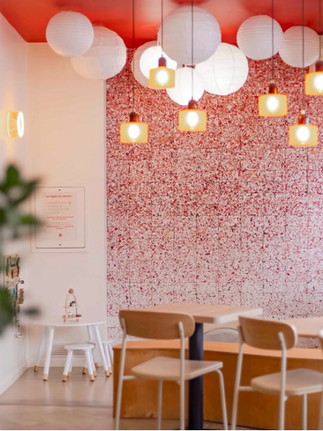
The story behind FabBRICK starts with the founder Clarisse Merlet coming up with the idea in 2016 while she was still in Architecture school. Merlet started to ideate FabBRICK once she learnt about the amount of global textile waste contributing to the landfill. In France alone, textile waste is estimated to be around 4 million tons, and less than a third of this is collected for reuse–can you imagine what it is for the entire world? In April of 2019, Clarisse and her team crowdfunded around $11,000 to develop a brick machine to industrialize the production process of turning two to three T-shirts’ into a single brick. After many trials, Merlet and team were able to invent a process that used all types of fabric–cotton, polyester, viscose and more–as well as the hardware to create a one-step process and reduce any additional waste. The company says the bricks are an excellent thermal and acoustic insulator, meaning that they work for room partitions, decorative walls, and even furniture such as lamps, tables, stools, etc.
FabBRICK is such an important company for both designing out waste by using recycled textiles and creating products that are fully recyclable, but also to prioritize local sourcing and closed-loop supply chains. Although sustainability is the main focus of the company, FabBRICK emphasizes using local textile waste and production to minimize environmental impact while supporting local economies at the same time. While they have made bricks that are able to be used within construction while being fire-resistant and moisture-resistant, Merlet is looking to find a way to help design them for more structural purposes beyond the already existing structures they’ve used the bricks for. Today we see FabBRICK sourcing material within a maximum radius of 100 km from Paris. Tomorrow the company hopes to see a FabBRICK factory in every region and country that produces textile waste.




Comments